Travel is one of the most enriching endeavors a person can undertake, but navigating unfamiliar environments also exposes us to unique vulnerabilities. In major urban centers in India, a new wave of street-level theft has emerged. These are not standard, brute-force pickpocketing incidents; instead, they are highly sophisticated social-engineering schemes that target human psychology, emotional anxiety, and digital dependencies.
By understanding the underlying mechanisms of these schemes—and how they exploit our cognitive biases—travelers and residents can build an impenetrable shield against deception. This article analyzes two real-world case studies from Hyderabad, India, to call out the exact modus operandi and provide actionable defense strategies. While these specific events are rooted in the Indian landscape, the underlying psychological manipulation and crowd exploits apply universally to any densely-populated global metropolis, from the crowded transit networks of Paris to the bustling tourist plazas of Rome.
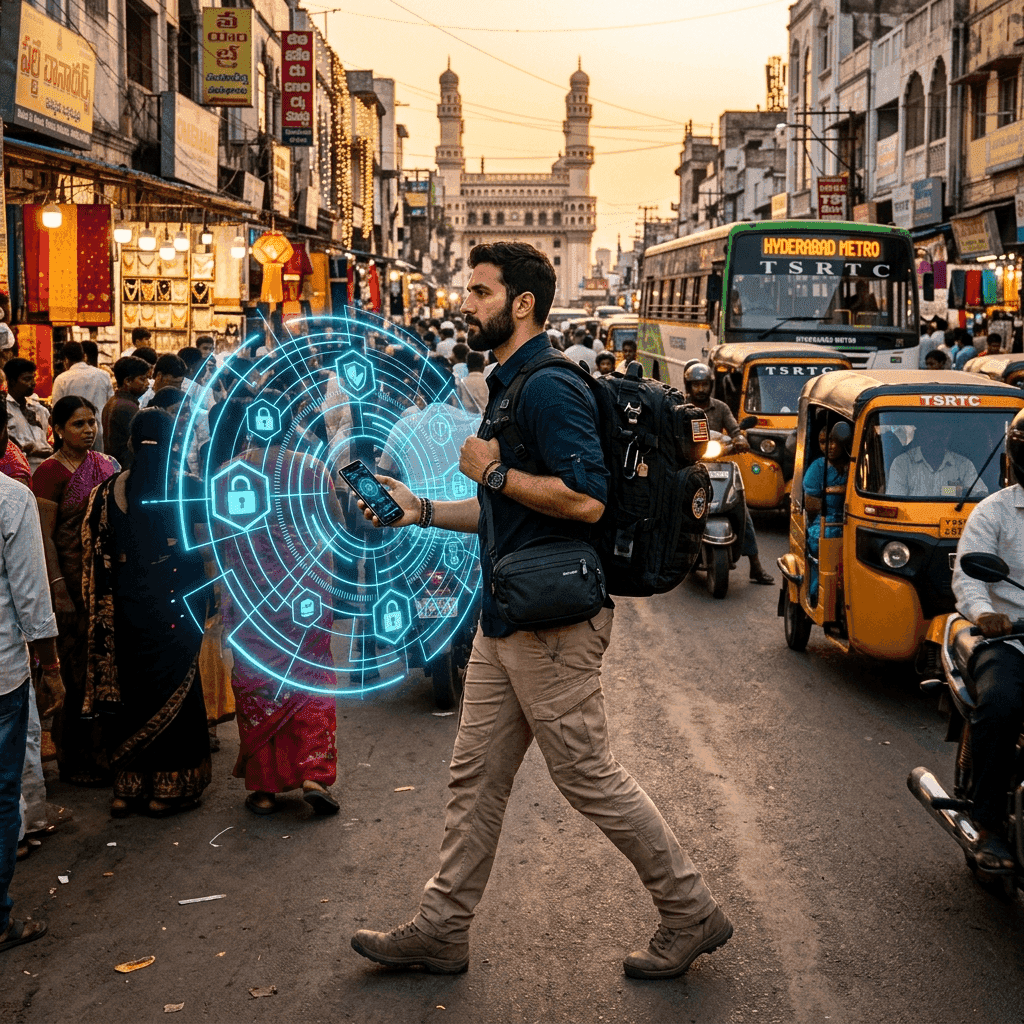
Case Study 1: The Distraction Trap at Crowded Venues
The first major scheme operates in high-density, chaotic family spaces. One of the most famous examples is the annual Numaish consumer exhibition in Hyderabad—an event that draws tens of thousands of visitors daily into a swirling sea of vendors, noise, and constant movement.
In these high-friction environments, a specific category of pickpocketing groups—often consisting of women clad in traditional burkhas—operates with extreme coordination.
The Modus Operandi
The scam relies entirely on sensory overload and social constraints:
- Target Selection: Scammers carefully select targets who are visibly occupied, especially families traveling with young children. A parent pushing a stroller, carrying a child, or managing shopping bags is physically compromised and cognitively divided. Crucially, high-status cues such as expensive-looking purses, designer wallets, or exposed premium jewelry are immediate beacons for these coordinated operators.
- The Cover of Anonymity: The use of traditional burkhas provides complete physical anonymity. In a dense Indian crowd, the garment blends in natively. More importantly, it exploits a strong cultural boundary in India: respect for women's personal space. Most travelers will instinctively avoid physical contact or questioning a woman in a burkha, creating a psychological barrier that shields the operator.
- The Bump and Swipe: Utilizing the natural crushing pressure of the crowd, the operators create artificial bottlenecks. As a parent navigates a tight space, one operator will bump into them or distract a child, while a second operator swiftly reaches into strollers, open diaper bags, loose pant pockets, or unsecured purses to swipe loose high-value items like phones, jewelry, or cash.
- Rapid Dispersal: Once the item is swiped, it is immediately passed to a third accomplice who melts away into the crowd. Even if the victim realizes the theft seconds later, identifying the specific operator in a sea of identical garments is nearly impossible, and physical searches are culturally taboo and legally complex.
- The Surveillance Bypass: Despite Numaish having CCTV cameras blanketed across the venue and constant, blaring loudspeaker announcements warning visitors to beware of pickpockets, these thefts continue unabated. The coordinated use of the burkha acts as a highly effective defense mechanism—bypassing digital surveillance through visual uniformity and disabling immediate street-level intervention due to cultural boundary constraints.
The Institutional Response: The Numaish Police Booth
If you fall victim at the exhibition, your first logistical step should be to visit the temporary police booth set up on-site to file a formal report. This is essential for insurance claims and official tracking, but managing your expectations is vital. Finding a stolen item in a crowd of fifty thousand is a statistical near-impossible task, and police resources are heavily stretched. Furthermore, a realistic traveler must acknowledge the systemic friction of the landscape: petty theft rings often rely on local corruption, occasionally working hand-in-glove with low-level local enforcement who turn a blind eye in exchange for a cut of the proceeds. Report the theft for the paperwork, but do not expect a recovery.
Case Study 2: The Sweet-Talk and Drain Bus Scam
The second scheme is even more dangerous, transitioning seamlessly from a physical pickpocketing incident to a total digital hijack. This scam typically occurs on crowded public transit buses, where travelers are closely packed and highly reliant on their mobile devices for navigation.
The Modus Operandi
This scheme is a masterclass in emotional manipulation and false security:
- The Physical Pickpocket: The initial theft is a standard transit swipe. The thief slides a mobile phone out of a traveler's pocket or bag during the boarding or alighting process.
- The Baiting Call: When the traveler realizes their phone is missing, their immediate reaction is to call their own number from a friend's phone or a public line. Instead of turning the phone off (which would immediately alert the victim to a permanent loss), the thief actually answers the call.
- The Cooperative Hook: The thief adopts an incredibly polite, cooperative, and reassuring persona. They sweet-talk the victim, saying: "I am a good person. I just found this phone on the bus floor. I want to return it to you. I am a traveler myself, and I understand how stressful this is." This completely disarms the victim's panic, replacing it with intense relief and gratitude.
- The Password Trap: The thief arranges a meeting point to return the phone. However, as the agreed time passes and the thief does not show up, the victim calls the thief back out of growing anxiety. The thief answers and exploits this leverage, sweet-talking the victim and claiming a logical hurdle: "I tried to unlock the screen to find your contact details or address, but it locked me out. Since we are communicating on a temporary line, I have no other way to contact you if we miss each other. To make sure I am meeting the right person and can read your coordinates, could you please give me your passcode so I can unlock it?"
- The Financial Drain: Desperate to secure the physical return of their expensive hardware, many victims willingly surrender their numerical passcode. The thief, maintaining their cooperative persona, ends the call on warm, reassuring terms to ensure the victim remains completely unsuspecting, and then immediately turns off the device. The victim typically only learns of the deception once it is too late and their bank accounts and credit cards are already being used. With the passcode, the thief bypasses all biometric locks (Face ID or fingerprint), opens the device, accesses digital bank accounts, retrieves UPI (Unified Payments Interface) wallets, and drains the victim's accounts within minutes.
The Psychological Aftermath: Disbelief, Anger, and Damage Control
Beyond the financial exposure, the immediate emotional toll of street theft is profound. Victims do not just lose hardware; they experience a swift, jarring cycle of psychological distress. First comes disbelief—the refusal to accept that a device or wallet that was in your hand moments ago is gone, leading to frantic, repetitive pocket checks. This quickly transitions into anger and self-blame, as you mentally replay the bump and blame your own momentary lapse in focus. The feeling of violation can completely ruin your day, casting a shadow of anxiety over the entire travel experience.
Moreover, this distress quickly ripples outward to family and travel companions. A sudden digital emergency hijacks the entire group's energy. Long-planned itineraries and sightseeing trips are abruptly halted, replaced by the high-stress logistics of calling international banks and navigating local police stations. The shared anxiety and disruption can easily turn a relaxing vacation into a tense, collective damage-control mission.
The ultimate scale of the loss depends entirely on two variables: the total value of what was taken (cash, cards, identity, or digital access) and how quickly you act to contain the damage. A swift response—remotely wiping a phone, locking credit cards, and alerting banks—can limit a theft to a minor hardware inconvenience. A delayed response, paralyzed by disbelief, gives scammers the critical window they need to bypass locks and compromise your financial security.
Defense in Depth: A Guide for Seniors and Less Tech-Savvy Users
As smartphones have evolved into a one-stop storage system for our identity, communication, and finances, they have also become a high-risk point of vulnerability. For older adults or anyone who may not be as technically savvy, navigating these security landscapes can feel overwhelming. However, protecting yourself does not require advanced computer science degrees; it requires a combination of common-sense physical habits and straightforward digital settings.
While these strategies are valuable for anyone, implementing this multi-layered protection framework is especially critical if you are a senior—or are helping older family members navigate digital security in India:
Physical Preparation and Venue Selection
- Leave the Valuables Behind: Street operators target conspicuous wealth. When visiting crowded marketplaces or exhibitions like Numaish, leave expensive jewelry, luxury watches, and designer purses at home or in a safe place. Dress down to blend in.
- Avoid High-Density Days: The risk of pickpocketing scales exponentially with crowd density. Plan your visits during weekdays and early afternoon hours. Avoid weekends, local holidays, and opening or closing weeks when venues are packed to capacity.
- Zip and Lock Down Your Gear: Never put your phone or wallet in an open pocket. Use bags with interior zippered compartments, or wear your backpack on your chest where you can physically feel and see the zippers at all times.
Financial and Digital Guardrails
- Isolate Your UPI Accounts: Unified Payments Interface (
UPI) apps like Google Pay, PhonePe, or Paytm are incredibly convenient in India, but they represent a direct link to your money. Never link your primary retirement or high-balance savings accounts to your mobile payment apps. Instead, open a secondary, low-balance bank account specifically for daily or travel spend and link your UPI apps only to that account. If your phone is compromised, the damage is capped at a minor amount. - Mandatory Biometric Locks: Go into your phone settings and ensure that Face ID or fingerprint authentication is mandatory not just to unlock the phone screen, but specifically to open each individual banking, payment, or financial app. Even if a thief coaxes your main screen passcode from you, they will still be blocked from your money without your physical face or fingerprint.
- Configure Secure Cloud Backups: Enable automatic nightly cloud backups (like Apple iCloud or Google One). Ensure that your photos, contacts, and critical documents are continuously saved. If your device is stolen, you can rest easy knowing you have lost a replaceable piece of glass and metal—not a lifetime of irreplaceable personal memories.
The Immediate Action Protocol
Disbelief and panic can cause costly delays. Prepare a physical, written index card (kept separate from your phone) with the following details:
- A list of all financial institutions, banks, and credit card issuers you use.
- Telephone numbers (specifically the official international customer care lines) for each bank.
- The contact details of your mobile service provider to block your SIM card immediately (preventing scammers from intercepting SMS verification codes).
If a theft occurs, do not spend hours calling your stolen phone or hoping for a sweet-talker to return it. Immediately consult your index card, call your banks, and freeze your accounts. Speed is your absolute best defense.
The Scammer's Toolkit: 3 Rules of Street Defense
These schemes prove that physical locks and technical security are only as strong as your psychological boundaries. To protect yourself in high-density travel corridors in India, you must adopt a strict, non-negotiable security framework:
- Rule 1: Treat Your Passcode as a Cryptographic Key: No legitimate good samaritan ever needs your screen passcode to return a lost phone. If someone claims they have your device and asks for the passcode to "verify ownership" or "unlock details," they are a scammer. Treat your passcode with the same absolute secrecy as your bank PIN.
- Rule 2: Secure Your Gear in Depths: Crowded festivals, exhibitions like
Numaish, and public buses are high-risk zones. Never carry high-value items in loose pockets, outer backpack compartments, or strollers. Use a high-quality money belt or secure zippered inner pockets close to your torso. - Rule 3: Establish a Digital Kill Switch: Before traveling, configure remote wipe capabilities (e.g., Apple's Find My or Android's Find My Device). If your phone is stolen, do not rely on cooperative phone calls. Immediately lock the device remotely and flag it as lost to secure your banking credentials.
Bottom Line: Security in the Indian Transit Landscape
The streets of India are beautiful, energetic, and highly rewarding to explore, but they require a high degree of situational awareness. Physical pickpocketing is a hardware loss; digital bank draining is a deep financial violation. By maintaining strict digital boundaries and understanding the psychological theatre of street manipulation, you can travel with confidence, keeping your focus on the incredible cultural experiences India has to offer.